





First-Trimester Combined Screening
Prenatal Diagnostics is one of the centers of excellence at Germano de Sousa Laboratories.
Our laboratories specialize in prenatal diagnosis, with a team of four specialized technicians led by Dr. Maria José Rego Sousa (see press publications). We have a fully equipped technical facility and technological support to perform these tests, meeting the highest quality standards for prenatal screening—specifically, the combined first-trimester screening.
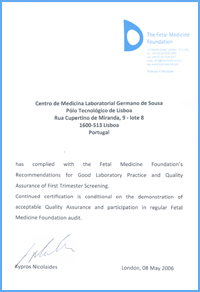
We are a Reference Laboratory of the Fetal Medicine Foundation (FMF) for Prenatal Diagnosis—First-Trimester Combined Screening.
On this page, we aim to provide all the essential information on the topic of prenatal diagnosis.

Certified by the Fetal Medicine Foundation
The Germano de Sousa Laboratory Medicine Center is certified by the Fetal Medicine Foundation (FMF) for Prenatal Diagnosis—First-Trimester Combined Screening, and is therefore an FMF Reference Laboratory for First-Trimester Prenatal Diagnosis.
The granting of FMF certification for Prenatal Diagnosis—First-Trimester Combined Screening—is contingent upon the acceptance of and compliance with a set of mandatory criteria, such as, for example:
- The acquisition of specific, highly precise and accurate equipment for measuring the biochemical parameters (PAPP-A—Pregnancy-Associated Plasma Protein A—and free ß-hCG — free β-subunit of Chorionic Gonadotropin), used in the Combined Risk Calculation.
- Participation in the External Quality Assessment (EQA) rounds of the “UK-NEQAS for Maternal Serum Screening in the First Trimester (Down’s).” Continued certification by the FMF is contingent upon demonstrating the results obtained in the aforementioned external quality assessment.
- Annual participation in audits conducted by the FMF itself, which also determine the continuation of certification.
- The use of software to calculate risk using a calculation algorithm approved by the FMF.
- The use, in the Combined Risk Calculation, of Nuchal Translucency (NT) and/or Nasal Bone (NB) measurements, performed by FMF-certified ultrasound physicians.
The Importance of Laboratory and Ultrasound Certification in Prenatal Screening:
Laboratory certification ensures the quality and reliability of biochemical results, as an integral part of the first-trimester Combined Risk Calculation, just as ultrasound certification ensures the quality and expertise of the measurements used in the first-trimester Combined Risk Calculation.

What is the Fetal Medicine Foundation?
The Fetal Medicine Foundation is a charitable organization dedicated to improving the health of pregnant women and their babies through research and education in fetal medicine.
The Foundation, with the support of an international group of experts, has developed an educational program for healthcare professionals and parents, as well as a series of certificates of proficiency in various aspects of fetal medicine.
Over the past 15 years, the Foundation has supported research and training in the following areas:
- Early diagnosis of fetal abnormalities
- Screening for chromosomal abnormalities
- Intrauterine fetal surgery
- Causes and prevention of miscarriage and stillbirth
- Prediction and prevention of preterm birth
- Preeclampsia and fetal growth restriction
- Problems with multiple pregnancies
- Development of safer techniques for prenatal diagnosis
The First-Trimester Combined Prenatal Screening Test is an early screening test designed to assess the risk of the fetus having Trisomy 21 (Down syndrome), Trisomy 13 (Patau syndrome), and Trisomy 18 (Edwards syndrome); it is not, in and of itself, a diagnostic test.
A test result indicating a low risk does not completely rule out the possibility that the baby has Trisomy 21, Trisomy 18, Trisomy 13, or another chromosomal abnormality, nor does it completely rule out the possibility of birth defects, intellectual disability, or other conditions not detectable by prenatal screening. However, in most cases, if the risk is low, it is unlikely that the baby has Down syndrome, trisomy 18, or trisomy 13.
The first-trimester combined prenatal screening test combines biochemical testing and ultrasound.
It detects 97% of cases, with a false-positive rate of 3%; this is a crucial factor for the couple to consider when deciding whether or not to undergo amniocentesis.
The biochemical test measures the levels of two substances present in the mother’s blood: PAPP-A (Pregnancy-Associated Plasma Protein A) and free ß-hCG (free beta subunit of human chorionic gonadotropin), both of which are highly sensitive for screening for trisomies 21, 18, and 13.
The ultrasound examination allows for the accurate determination of gestational age based on the crown-rump length (CRL), enables the precise measurement of the subcutaneous space located at the back of the fetus’s neck (nuchal translucency—NT), and assess the presence of the nasal bone (ON/N Screening B).
The screening should be performed between the 11th week and the 13th week plus 6 days of gestation (first trimester).
This timeframe was chosen because it allows for the detection of nuchal translucency, one of the markers with the highest sensitivity and specificity for detecting Down syndrome.
Nuchal translucency is a non-echogenic space located between the skin and the soft tissues at the level of the cervical spine and is present only during the first trimester of pregnancy.
The risk of chromosomal abnormalities increases with the thickness of nuchal translucency.
The success rate for obtaining a nuchal translucency measurement between 10 and 13 weeks is 75%.
Combining maternal age (MA), nuchal translucency (NT) measurement, the presence of the nasal bone (NB), and the biochemical markers hCG and PAPP-A in the first trimester (between 11–13 weeks + 6 days), a detection rate of 95–97% of cases is achieved.
MA + NT and NB + fßhCG + PAPP-A at 11–13+6d | 95–97%
It is important to minimize the expectant mother’s anxiety; it is also worth emphasizing the importance of performing this screening in the first trimester, thereby allowing for timely action to be taken if necessary.
The Germano de Sousa Laboratory Medicine Center delivers results within 24 hours.
For a reliable interpretation of the risk calculation, the laboratory needs to gather information from the biochemical test, the ultrasound exam, and essential clinical information about the pregnant woman.
Therefore, it is necessary to have information regarding gestational age, maternal age, ethnicity, the mother’s weight, the presence of diabetes, smoking habits (whether she smokes and the number of cigarettes per day), whether she has undergone any assisted reproductive technology, whether she has any autoimmune disease, and whether there was a chromosomal abnormality in a previous pregnancy.
Information for Physicians
When clinical information about the pregnant woman, the results of the biochemical screening, and the ultrasound findings are entered into the software, it is possible to calculate the risk level for Trisomy 21, Trisomy 13, and Trisomy 18.
A questionnaire has been developed that must be completed by the attending physician when the pregnant woman undergoes prenatal diagnosis.
See:
Prenatal Diagnosis Questionnaire (download)
Download our prescription form
Information for Pregnant Women
When you undergo prenatal screening, you will need to fill out a questionnaire with your doctor that includes essential information for this screening. You must enter the results of the biochemical test, the ultrasound data, and the questionnaire information into the software to calculate the risk for Trisomy 21, Trisomy 13, and Trisomy 18.
Prenatal Diagnostic Questionnaire (download)
It is very important for the accuracy of prenatal diagnosis that the pregnant woman inform the laboratory of the pregnancy outcome.
This allows us to evaluate the results, thereby ensuring a detection rate of between 95% and 97% with a false-negative rate of 3%. When a pregnant woman undergoes prenatal diagnosis, the laboratory provides an information sheet regarding the course and outcome of the pregnancy.
Learn more about the Harmony Prenatal Test™—the latest advancement in prenatal screening, now available in Portugal at the Germano de Sousa Group Laboratories.

Operating as an Integrated Center
The Dr. Germano de Sousa Laboratory Medicine Center, together with centers staffed by certified sonographers or in partnership with public or private hospitals, forms Integrated Centers.
The Integrated Center allows couples to learn their risk level for trisomies 21, 18, and 13 on the same day they visit the healthcare facility for blood collection and an ultrasound, without any additional inconvenience—whether in terms of travel or waiting time for the results of the First-Trimester Combined Screening—which provides greater peace of mind for the vast majority of couples at a very early stage of pregnancy.
Standard Procedure at an Integrated Center
The blood collection is performed at the same health facility the patient visits to have the ultrasound and/or consult with the obstetrician monitoring her pregnancy.
Once drawn, the blood is transported to the Central Laboratory via a courier service that makes regular stops at the collection sites. At the Central Laboratory, the blood is processed, and within 24 hours, the biochemical results for PAPP-A and free ß-HCG become available online for the ultrasound physician to view using a password exclusive to that physician, who can thus access the results for their patients (and only their patients). At a time of their choosing, they enter these laboratory results into the software—which uses an approved algorithm to determine the risk level—located in their ultrasound/consultation office.
This completes the Integrated Center concept, providing the couple with information regarding the risk level of their current pregnancy on the same day. This information effectively eliminates the anxiety associated with this type of procedure, providing reassurance to the vast majority of couples who seek it early in their pregnancy.
Procedure at the Germano de Sousa Laboratory Medicine Center
When you go to have your blood drawn at one of the laboratory’s collection points, be sure to bring your ultrasound report and the prescription from your attending physician. After the collection, the blood is processed; as soon as the biochemical results for PAPP-A and free B-HCG are available, they are entered—along with the ultrasound results—into software using an algorithm approved by the FMF to calculate the risk associated with the current pregnancy.
Within 24 hours, you will receive the report for the first-trimester Combined Prenatal Screening; this report is sent via email or mail directly to your attending physician.
Do you have questions about prenatal diagnosis? Check out our article with questions and answers about prenatal screening.
If you have any questions, please contact us.
We'll be happy to help.
CLINICAL PATHOLOGY LABORATORY

Related news:
O Rastreio do citomegalovírus na vigilâ… | 2016
Artigo da Profª Doutora Maria José Rego de Sousa no Sapo Lifestyle sobre o rastreio do citomegaloví…
Read more
Serologia da Rubéola no Pré-Natal | 2015
Artigo da Profª Doutora Maria José Rego de Sousa no Sapo Lifestyle sobre os testes serológicos para…
Read more
A importância do rastreio da rubéola na… | 2015
Artigo da Profª Doutora Maria José Rego de Sousa no Sapo Lifestyle sobre o rastreio da rubéola na v…
Read more
Harmony™ Prenatal Test | 2013
A Ariosa Diagnostics, Inc., fabricante e executante do Harmony ™ Prenatal Test, anunciou hoje que t…
Read more
Rastreio combinado: maior taxa de detec… | 2006
Um em cada 700 fetos é afectado pela trissomia 21
Read moreRelated articles:

Harmony® Prenatal Screening
Harmony® Prenatal Screening represents the greatest advance in the field of non-invasive prenatal testing for the screening of the three main trisomies (T21, 18, 13) and aneuploidies related to the s…
Read more
Preeclampsia Screening - 1st Trimester
The Center for Laboratory Medicine is the first and only national laboratory to provide the means for the early screening of preeclampsia.
Read more
Prenatal Screening
First-Trimester
Combined Screening
The Germano de Sousa Laboratory Medicine Center is certified by the Fetal Medicine Foundation (FMF) for Prenatal Diagnosis · First-Trimester Combined Screening, an…

Prenatal Screening Tests: Differences and Benefits
Pregnancy is a special time full of anticipation, but it also requires making informed decisions about the baby's health.
Read more
Prenatal Screening: What Is It and Why Is It Important?
Pregnancy is a time filled with emotions, discoveries, and doubts—especially when it comes to the baby's health.
Read more
Questions and Answers About Prenatal Screening
The Germano de Sousa Laboratory Medicine Center is certified by the Fetal Medicine Foundation (FMF) for Prenatal Diagnosis • First-Trimester Combined Screening, and is therefore an FMF Reference Labo…
Read more
Risk Values for Trisomy 21
Prenatal Diagnosis – First-Trimester Combined Screening makes it possible to determine the probability of trisomy 21 (Down syndrome) in maternal blood, as well as the presence of other genetic abnorm…
Read more
Serene Non-Invasive Prenatal Screening
The most comprehensive answer to trisomies 21, 18, and 13; sex chromosome aneuploidies; and microdeletions and microduplications.
Read more
Signs of Trisomy 21 During Pregnancy
Often referred to as Down syndrome, it is a genetic condition resulting from an extra copy of chromosome 21, instead of the usual pair. This genetic condition (aneuploidy) can lead to developmental d…
Read more
What is Trisomy 21?
Known as Down syndrome or trisomy 21, it results from an abnormality in the cell division process of the fertilized egg, causing the individual to develop an extra copy of chromosome 21. In other wor…
Read more
Women's Laboratory
The Germano de Sousa Laboratory Medicine Center is certified by the Fetal Medicine Foundation (FMF), which is the world’s leading authority in the field of maternal-fetal medicine and research, direc…
Read more