





First-Trimester Combined Screening
The 1st-Trimester Combined Prenatal Screening is a test that assesses the risk of the fetus having Trisomy 21 (Down syndrome), Trisomy 18 (Edwards syndrome), and Trisomy 13 (Patau syndrome).
These trisomies—so named because a trio of chromosomes replaces the usual pair of chromosomes 21, 18, or 13, are characterized by varying degrees of severity—ranging from mental retardation to various malformations—that can affect different systems and organs and may even threaten the fetus’s very survival; this is particularly true in cases of trisomy 13, for example.
The prevalence of each varies:
- Trisomy 21: 1 in every 700 births.
- Trisomy 18: 1 in every 8,000 births.
- Trisomy 13: 1 in every 20,000 births.
Why Should You Consider Prenatal Screening?
Prenatal screening is an important tool for detecting Down syndrome. Maternal age alone allows for the detection of about 30% of cases. When maternal age is combined with an ultrasound exam, the detection rate increases to about 75% of cases. When biochemical testing (first-trimester combined screening) is added, the detection rate rises to about 90 to 97% of cases.
The risk of trisomy 21, 18, and 13 increases with maternal age, especially after age 35.
While prenatal screening is not a diagnostic test in and of itself, it also does not completely rule out the possibility that the fetus may develop anomalies or birth defects that may not be identified during screening.
Definitive Diagnosis
A definitive diagnosis of the aforementioned malformations can only be made through invasive tests, such as chorionic villus sampling (CVS) or amniocentesis, which allow for the collection of cells to study the baby’s karyotype. These are invasive procedures that carry a risk of miscarriage (0.5 to 1.0%).
First-Trimester Combined Prenatal Screening is an early screening test and plays an important role in the decision to undergo amniocentesis. It is recommended for all pregnant women, regardless of age. Although it is highly effective at estimating the probability that the fetus is affected by the aforementioned trisomies, it does not rule out the possibility that the fetus may be affected by other chromosomal abnormalities or birth defects.
How Is Prenatal Screening Performed?
First-trimester combined prenatal screening consists of an ultrasound examination combined with the measurement of biochemical markers in the mother’s blood. The ultrasound examination aims to assess fetal anatomy and evaluate the key markers associated with these conditions.
Based on the results, it is possible to determine an individualized combined risk for each pregnant woman for each of the trisomies being screened for.
Assessment of the risk of trisomy 21
The individual risk for each pregnancy can be assessed with high accuracy using the first-trimester combined prenatal screening, allowing parents to make an informed decision about whether or not to undergo an invasive test. The combined screening test calculation should be performed between the 11th and 13th week plus 6 days of gestation,
Thus, prenatal screening combines information from the ultrasound examination with the biochemical measurement of two hormones in the mother’s blood:
Ultrasound
It allows for the accurate determination of gestational age through the Crown-Rump Length (CRL) and evaluates specific markers related to trisomies, such as:
- Nuchal Translucency (NT)
- Nasal Bone (NB)
Biochemical testing
This test measures levels of two maternal hormones, PAPP-A and free ß-hCG, both of which are highly sensitive for screening for the aforementioned anomalies.
- Pregnancy-Associated Plasma Protein A (PAPP-A).
- Free β-subunit of Chorionic Gonadotropin (free β-hCG).
By combining the measurements obtained through ultrasound examinations with the pregnant woman’s demographic data (maternal age, etc.) and the results of the biochemical test, the combined risk for trisomy 21, 18, and 13 is determined.
Fetal Medicine Foundation Certification
The Germano de Sousa Laboratory Medicine Center, a national leader in the fields of Clinical Pathology and Clinical Laboratory Testing, is certified by the Fetal Medicine Foundation (FMF), the leading organization in fetal medicine in Europe and recognized worldwide.

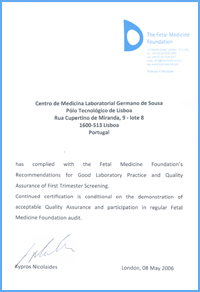
Contact our Prenatal Diagnostics department directly at prenatal@cm-lab.com. We’ll answer all your questions and help you make informed decisions about your baby’s health.
If you have any questions, please contact us.
We'll be happy to help.
CLINICAL PATHOLOGY LABORATORY

Related news:
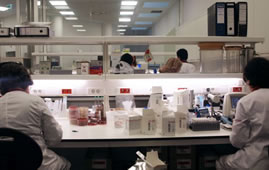
O Rastreio do citomegalovírus na vigilâ… | 2016
Artigo da Profª Doutora Maria José Rego de Sousa no Sapo Lifestyle sobre o rastreio do citomegaloví…
Read more
Serologia da Rubéola no Pré-Natal | 2015
Artigo da Profª Doutora Maria José Rego de Sousa no Sapo Lifestyle sobre os testes serológicos para…
Read more
A importância do rastreio da rubéola na… | 2015
Artigo da Profª Doutora Maria José Rego de Sousa no Sapo Lifestyle sobre o rastreio da rubéola na v…
Read more
Related articles:
Center of Excellence in Prenatal Diagnosis
Prenatal Diagnostics is one of the Centers of Excellence at Germano de Sousa Laboratories.
Read more
Harmony® Prenatal Screening
Harmony® Prenatal Screening represents the greatest advance in the field of non-invasive prenatal testing for the screening of the three main trisomies (T21, 18, 13) and aneuploidies related to the s…
Read more
Preeclampsia Screening - 1st Trimester
The Center for Laboratory Medicine is the first and only national laboratory to provide the means for the early screening of preeclampsia.
Read more
Prenatal Screening Tests: Differences and Benefits
Pregnancy is a special time full of anticipation, but it also requires making informed decisions about the baby's health.
Read more
Prenatal Screening: What Is It and Why Is It Important?
Pregnancy is a time filled with emotions, discoveries, and doubts—especially when it comes to the baby's health.
Read more
Questions and Answers About Preeclampsia
Preeclampsia is a condition that begins early in pregnancy. Its diagnosis is based on signs and symptoms and is only possible once the condition manifests. First-Trimester Preeclampsia Screening allo…
Read more
Questions and Answers About Prenatal Screening
The Germano de Sousa Laboratory Medicine Center is certified by the Fetal Medicine Foundation (FMF) for Prenatal Diagnosis • First-Trimester Combined Screening, and is therefore an FMF Reference Labo…
Read more
Risk Values for Trisomy 21
Prenatal Diagnosis – First-Trimester Combined Screening makes it possible to determine the probability of trisomy 21 (Down syndrome) in maternal blood, as well as the presence of other genetic abnorm…
Read more
Serene Non-Invasive Prenatal Screening
The most comprehensive answer to trisomies 21, 18, and 13; sex chromosome aneuploidies; and microdeletions and microduplications.
Read more
Signs of Trisomy 21 During Pregnancy
Often referred to as Down syndrome, it is a genetic condition resulting from an extra copy of chromosome 21, instead of the usual pair. This genetic condition (aneuploidy) can lead to developmental d…
Read more
What is Trisomy 21?
Known as Down syndrome or trisomy 21, it results from an abnormality in the cell division process of the fertilized egg, causing the individual to develop an extra copy of chromosome 21. In other wor…
Read more
Women's Laboratory
The Germano de Sousa Laboratory Medicine Center is certified by the Fetal Medicine Foundation (FMF), which is the world’s leading authority in the field of maternal-fetal medicine and research, direc…
Read more