





Skin cancer is one of the most common forms of cancer, and if detected early, it has a high cure rate. Skin cancer screening is an essential tool for identifying suspicious lesions before they become more serious. It is essential to understand the importance of early diagnosis and prevention, to know how to perform skin cancer screening, and to protect your health.
The Importance of Skin Cancer Screening
Early Diagnosis
Skin cancer screening aims to identify changes in the skin that may indicate the presence of cancer. Early diagnosis is crucial because it allows treatment to begin at an early stage, when the cancer is easier to treat and success rates are higher. Detecting this cancer early can reduce the need for more aggressive treatments and significantly improve the patient’s prognosis.
Reduced Mortality
Skin cancers, such as melanoma, can be fatal if not treated in time. Regular skin cancer screening and early diagnosis can save lives by reducing mortality associated with these conditions. Studies show that early detection of melanoma is associated with a five-year survival rate of over 90%.
Detection of precancerous lesions
Skin cancer screening also helps identify precancerous lesions, such as actinic keratosis, which have the potential to develop into cancer if left untreated. By removing these lesions early, it is possible to prevent the development of this disease.
How to Screen for Skin Cancer
Self-Examination
Performing regular self-exams of your skin is one of the most effective ways to detect suspicious changes. It is recommended that you perform a skin self-exam once a month, using a full-length mirror and a hand mirror to check all areas of your body, including your back, scalp, soles of your feet, and between your toes. Skin cancer screening through self-examination is a vital practice for early detection.
Steps for a Self-Exam
- Get ready: Undress completely and be in a well-lit area.
- Examine your entire body: Use the full-length mirror to check your face, neck, torso, arms, and legs. Use the hand mirror to examine hard-to-reach areas, such as your back and the backs of your legs.
- Look closely: Look for new marks or changes in existing ones. Pay attention to spots, papules, lesions, or discolored areas.
- Use the ABCDE method: Evaluate moles using the ABCDE method (Asymmetry, Borders, Color, Diameter, Evolution). Any mole with suspicious characteristics should be evaluated by a dermatologist.
For more details on the symptoms to look for, see the article: What Are the Symptoms of Skin Cancer?
Dermatological Examination
In addition to self-exams, it is essential to undergo regular dermatological exams. A dermatologist can identify moles that have been overlooked and perform biopsies on suspicious lesions for an accurate diagnosis. An annual visit to a dermatologist is recommended, but the frequency may need to be increased for people at higher risk, such as those with a family history or frequent sun exposure.
Procedures During a Dermatological Exam
- Medical history: The dermatologist will ask questions about your medical and family history, sun exposure, and any recent changes in your skin.
- Physical examination: A complete skin examination will be performed, including areas not exposed to the sun.
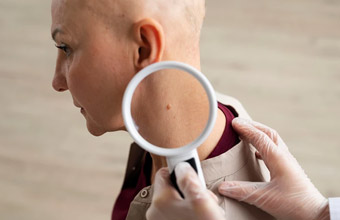
- Dermatoscopy: Use of a dermatoscope to examine suspicious lesions in detail. This device magnifies the view of the skin and helps identify characteristics of skin cancer.
- Biopsy: If necessary, a biopsy will be performed to obtain a skin sample for laboratory analysis.
Advanced Diagnostic Techniques
Some advanced techniques are also available for skin cancer screening:
- Full-body photography: High-resolution photographs of the entire body are taken to monitor changes over time.
- Confocal microscopy: This technique uses a laser to obtain detailed images of the skin’s layers without the need for an invasive biopsy.
- AI and diagnostic algorithms: Artificial intelligence tools are being developed to help identify suspicious lesions based on large databases of skin cancer images.
Prevention
Prevention is an essential component in the fight against this disease. Taking preventive measures can significantly reduce the risk of developing the disease.
Sun Protection
Sun exposure is the main risk factor for this disease. To protect your skin, follow these recommendations:
- Use sunscreen: Apply a broad-spectrum sunscreen with an SPF of at least 30, even on cloudy days. Reapply every two hours and after swimming or sweating.
- Wear protective clothing: Wear wide-brimmed hats, UV-protective sunglasses, and long-sleeved shirts and long pants when outdoors.
- Seek shade: Avoid direct sun exposure between 10 a.m. and 4 p.m., when UV rays are strongest.
- Avoid tanning beds: Using tanning beds increases the risk of skin cancer. Opt for safe self-tanners instead of exposing yourself to artificial UV radiation.
Education and Awareness
Education about the risks of this disease and preventive measures is crucial. Participate in awareness campaigns and encourage family and friends to adopt safe sun protection practices.
Healthy Lifestyle
Adopting a healthy lifestyle can strengthen the immune system and aid in prevention:
- Balanced diet: Eat a diet rich in fruits, vegetables, whole grains, and lean proteins. Antioxidants found in foods such as citrus fruits, berries, and leafy green vegetables can help protect the skin.
- Hydration: Drink plenty of water to keep your skin hydrated and healthy.
- Regular exercise: Engage in physical activity regularly to improve overall health and well-being.
- Avoid tobacco and excessive alcohol: Smoking and excessive alcohol consumption can weaken the immune system and increase the risk of cancer.
The Importance of a Personalized Skin Cancer Screening Plan
Every person is unique, and the risk of this disease can vary significantly. A personalized skin cancer screening plan, developed with the help of a dermatologist, can provide the best possible protection. This plan should take into account factors such as family history, skin type, sun exposure, and other individual risks.
Regular Checkups
Depending on your personal risk, your dermatologist may recommend more frequent checkups or specific skin cancer screening techniques. High-risk individuals may need dermatological exams every six months.
Ongoing Monitoring
Continuous monitoring of skin changes is crucial for the early detection of cancer. Use tools such as skin-monitoring apps, which allow you to record and track changes over time, making it easier to identify concerning changes.
For more information on how to prevent this disease, see the article: What Is Skin Cancer and How to Prevent It.
Take Care of Your Skin: Prevention and Screening Are Essential
Skin cancer screening is vital for early and effective detection. Combined with preventive measures, such as sun protection and a healthy lifestyle, it can significantly reduce your risk of developing this condition. Remember to perform regular self-exams, consult a dermatologist, and follow a personalized skin cancer screening plan.
To better understand what cancer is and the different ways it can manifest, we recommend reading the article: What Is Cancer?
To undergo diagnostic tests and ensure your health, visit our collection points. Prevention is the best medicine!
If you have any questions, please contact us.
We'll be happy to help.
CLINICAL PATHOLOGY LABORATORY

Related news:
Cancro da pele não melanoma: os dois ti… | 2024
O cancro da pele não melanoma resulta de uma perturbação do normal ciclo da vida das células, onde …
Read more
Novo teste não invasivo consegue deteçã… | 2024
O teste Avantect vem mudar o paradigma da deteção do cancro pancreático: Inclui no seu algoritmo o …
Read more
Cancro do pâncreas: Germano de Sousa pr… | 2024
O Centro de Medicina Laboratorial Germano de Sousa promoveu esta quinta-feira um workshop sobre ava…
Read more
AVANTECT – TESTE NÃO INVASIVO PARA DETE… | 2024
O teste Avantect vem mudar o paradigma da deteção do cancro pancreá- tico:
Read moreGrupo Germano de Sousa aposta na preven… | 2023
90% dos cancros da mama podem ser vencidos se forem detetados precocemente* e por isso, o Grupo Ger…
Read more
Outubro Rosa: Marcas juntam-se à luta c… | 2023
Para assinalar o Mês da Sensibilização para o Cancro da Mama e o Dia Internacional do Cancro da Mam…
Read more
Grupo Germano de Sousa Lança Campanha d… | 2023
De norte a sul do país, visite um posto de colheitas Germano de Sousa e dê “cara” a esta campanha …
Read more
Grupo Germano de Sousa lança campanha d… | 2023
O Grupo Germano de Sousa lançou uma campanha de sensibilização e prevenção sobre o cancro da mama, …
Read more
Prevenção contra o cancro da mama – Uma… | 2023
Em 90% dos casos dos cancros da mama podem ser vencidos se forem detetados precocemente. “Prevenção…
Read more
CAMPANHA DE PREVENÇÃO CONTRA O CANCRO l… | 2023
De norte a sul do país, visite um posto de colheitas Germano de Sousa e dê “cara” a esta campanha n…
Read more
Das águas às toalhas: Marcas não esquec… | 2022
No mês em que se celebra o Dia Mundial Contra o Cancro da Mama, também conhecido como “Outubro Rosa…
Read more
Teste uromonitor: a vigilância não-inva… | 2021
Devido às elevadas taxas de recorrência e ao risco de progressão do cancro da bexiga, frequentement…
Read moreRelated articles:

Avantect Test for Pancreatic Cancer Detection
Avantect Test for Pancreatic Cancer Detection
Read more
Breast Cancer Screening: When and How to Get Screened
Breast cancer screening is one of the most effective ways to detect this type of cancer in its early stages, significantly increasing the chances of successful treatment.
Read more
Breast Cancer Symptoms: Recognize the Early Signs
This cancer is one of the most common diseases among women, and early detection is essential to increasing the chances of successful treatment. Recognizing the early symptoms of breast cancer can mak…
Read more
Breast Cancer: Learn How to Prevent It and Protect Yourself
Breast cancer is one of the most common diseases among women and is one of the leading causes of cancer-related deaths worldwide.
Read more
Cancer and Genetics
Cancer and genetics are inextricably linked: cancer essentially results from the accumulation of errors in our DNA that compromise cell function and enable them to exhibit oncogenic behavior.
Read more
Center of Excellence for HPV and Cervical Cancer
Laboratory diagnosis of HPV (human papillomavirus) is one of the centers of excellence at the Germano de Sousa Center for Laboratory Medicine...
Read more
Diagnosis of Cervical Cancer
Cervical cancer is, therefore, a rare complication of a common infection. However, it is also one of the most preventable forms of cancer in humans.
Read more
Oncology: the science that studies cancer
The term “oncology” comes from the Greek word onkos (meaning mass or volume) and the suffix -logia (meaning study). Consequently, oncology is a branch of medicine and science dedicated to the diagnos…
Read more
Pancreatic Cancer: Symptoms and Warning Signs
Pancreatic cancer results from an abnormality in the process of cell regeneration in the tissues that make up the pancreas. In Portugal, there are 1,000 new cases of pancreatic cancer each year.
Read more
Pancreatic Cancer: What It Is, Causes, and Risk Factors
Pancreatic cancer is a malignant tumor that affects the pancreas. Among tumors affecting the digestive and endocrine systems, it has the worst prognosis.
Read more
The Impact of a Breast Cancer Diagnosis on the Family
When we talk about breast cancer and the professionals who treat it, we must bear in mind the inherent complexity of cancer. It affects not only the person diagnosed, but also their family and the br…
Read more
What is cancer?
Cancer, malignant neoplasm, or neoplasm are medical terms that describe the growth of abnormal cells in the body. These cells can metastasize and invade other healthy tissues, giving rise to a tumor.
Read more
What Is Skin Cancer and How to Prevent It
Skin cancer is one of the most common forms of cancer and occurs when skin cells mutate and grow uncontrollably.
Read more