





How to Diagnose Alzheimer's—A Neurodegenerative Disease
What is Alzheimer’s?
Alzheimer’s is the most common form of progressive dementia, affecting millions of people worldwide and causing a continuous and irreversible loss of various cognitive functions, including memory, concentration, attention, and language.
Understanding this neurodegenerative disease is essential for recognizing the early signs of the condition, enabling timely intervention to slow its progression and improve the quality of life for patients and their families.
Knowledge about how to diagnose Alzheimer’s contributes to greater awareness and understanding of how to prevent this complex condition, providing appropriate support and care to those affected by this challenging disease.
Therefore, understanding what Alzheimer’s is allows for a deeper understanding of the symptoms of dementia and how to diagnose it.
Diagnosing Dementia
Before beginning any investigation into how to diagnose Alzheimer’s, it is recommended to first schedule a genetic counseling consultation to rule out any suspicion of familial transmission (early-onset), especially when symptoms of Alzheimer’s are detected at age 50.
The progression of dementia varies from person to person, but cognitive decline affects the patient’s functional ability, making it difficult to perform basic daily tasks and leading to a state of total dependence, with a significant impact on both the patient and their family members.
Step 1 – Warning Signs
The first step in the process of diagnosing Alzheimer’s involves a detailed analysis of the patient’s medical history. Symptoms vary depending on the stage of the disease, but there are common signs, such as:
- Memory loss and forgetfulness
- Spatial and temporal disorientation
- Personality changes
- Difficulty performing daily tasks
- Mood swings and irritability
- Difficulty with verbal communication and self-expression
- Social isolation and loss of interest in previously enjoyed activities
It is often difficult to distinguish the symptoms of the disease from the normal aging process, which shares some similar characteristics. The progression of symptoms is gradual and may go unnoticed for a long time, without any action being taken.
Step 2 – Clinical Diagnosis
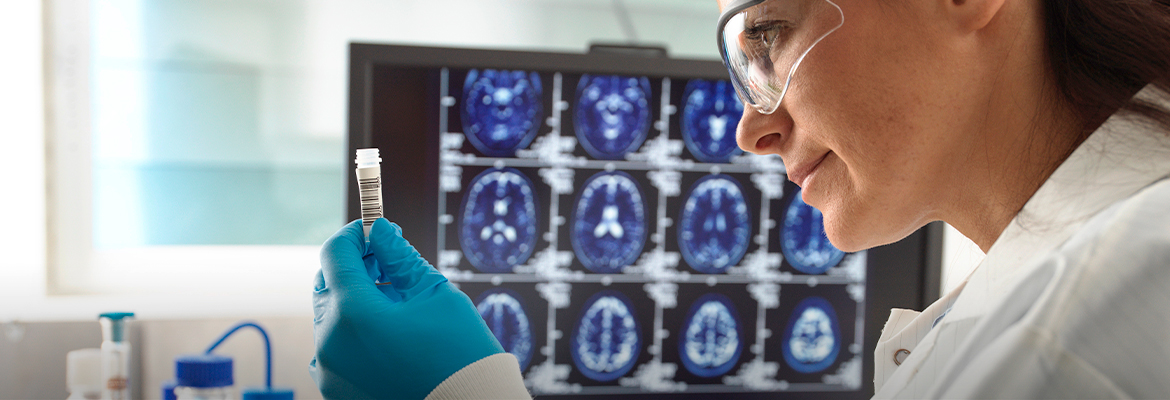
The second step in diagnosing Alzheimer’s disease relies on complementary imaging techniques. These tests allow for an assessment of the brain’s condition, the identification of structural changes, and the detection of β-amyloid and tau proteins outside the neurons—also known as “senile plaques.”
These techniques, such as computed tomography (CT), Magnetic Resonance Imaging (MRI), Single-Photon Emission Computed Tomography (SPECT), or Positron Emission Tomography (PET), help identify the anatomical changes in the brain that are characteristic of the disease.
Laboratory Tests: How to Diagnose Alzheimer’s
Neurochemical markers play a critical role in the early detection of dementia. Through laboratory tests, it is possible to diagnose Alzheimer’s with a sensitivity of 94% to 100%, even before the first symptoms and signs appear.
In this context, laboratory tests include analysis of the patient’s cerebrospinal fluid (CSF) to investigate the presence of β-amyloid and tau protein—the primary markers of the disease.
In addition, testing for the presence of the APOE4 gene may indicate a higher risk of developing the disease.
Blood Biomarkers
Research shows that certain biomarkers found in the blood can aid in the early detection of dementia, leading to improvements in patients’ quality of life.
As such, this approach offers a less invasive and more accessible alternative for detecting the disease, especially in its early stages.
The Crucial Role of Diagnosis
Knowing how to diagnose Alzheimer’s is essential to ensuring effective treatment and proper management of this neurodegenerative disease. Early detection of dementia helps improve patients’ quality of life by enabling more timely intervention.
The laboratories at the Germano de Sousa Center for Laboratory Medicine, a national leader in the fields of Clinical Pathology and Clinical Testing, are equipped to provide all the necessary support during this crucial stage.
Visit the “Collection Points” page for more information on the locations of our services.
If you have any questions, please contact us.
We'll be happy to help.
CLINICAL PATHOLOGY LABORATORY

Related news:

Marcadores no diagnóstico da doença de … | 2022
Não existe um exame específico para o diagnóstico da Doença de Alzheimer.
Read more
Quais os genes associados à doença de A… | 2022
As doenças genéticas e o seu carácter hereditário influenciam as decisões pessoais, os projetos de …
Read more
Alzheimer: qual a génese da doença? - S… | 2022
A doença de Alzheimer é uma doença neurodegenerativa, considerada uma das formas mais comuns de dem…
Read moreRelated articles:

Alzheimer's Disease
Alzheimer's disease is a neurodegenerative disorder considered the most common form of progressive dementia, affecting older adults. However, the diagnosis can also occur in cases of hereditary forms…
Read more
Symptoms of Alzheimer's at Age 50
Alzheimer's, a common neurodegenerative disease, is often associated with advanced age. However, it is crucial to recognize that symptoms of Alzheimer's can appear as early as age 50, especially in c…
Read more