





Serological Diagnosis
What Is the Syndrome?
Antiphospholipid Syndrome (APS), also known as Hughes Syndrome (named after the physician who first described this condition), is an immune system disorder characterized by excessive blood clotting and/or complications that occur during pregnancy (recurrent miscarriages, preterm births, stillbirths, etc.) and by the presence, in the blood, of autoantibodies directed against phospholipids or plasma proteins bound to phospholipids (anti-cardiolipin antibodies, anti-β2-glycoprotein I antibodies, lupus anticoagulant).
Epidemiology
Antiphospholipid Syndrome (APS) occurs most commonly in adolescents and young adults, but it can also be present in children and older adults.
The condition accounts for about 20% of recurrent thromboses in young people and 15% of cases of recurrent fetal loss.
In systemic lupus erythematosus (SLE), approximately 35% to 40% of patients have antiphospholipid autoantibodies (aPL). aPL are found in 1–5% of the healthy population.
Anticardiolipin autoantibodies (aCL) are more commonly found in the elderly.
The prevalence is higher among Black individuals. The predominance in females stems from its association with SLE and other connective tissue diseases, which also predominantly affect women.
Antiphospholipid Autoantibodies
Antiphospholipid autoantibodies have been associated with a wide range of conditions:
- Venous or Arterial Thrombosis (DVT, stroke, myocardial infarction, phlebitis)
- Recurrent spontaneous abortions (> 2 or 3rd trimester; preeclampsia)
- Intrauterine growth restriction (IUGR) (placental insufficiency)
- Abnormally low platelet counts (thrombocytopenia)
- Hemolytic Anemia
- Pulmonary Thromboembolism and Pulmonary Hypertension
- Raynaud’s syndrome
- Neurological manifestations (chorea, headaches, epilepsy, transverse myelitis)
- Skin manifestations, such as a purplish discoloration of the skin (livedo reticularis)
Antiphospholipid autoantibodies may be detected, albeit transiently, in the blood of patients with certain conditions, such as bacterial and viral infections (hepatitis, HIV) and parasitic infections.
It can be classified as:
- Primary APS (when it occurs in isolation)
- Secondary APS (in combination with other autoimmune diseases, e.g., SLE)
- Catastrophic APS (CAPS), a severe and often fatal manifestation characterized by multiple organ infarcts occurring over a period of days or weeks. It occurs in less than 1% of patients and requires urgent intervention (sudden multi-organ failure).
Classification Criteria (Sydney 2004)
Clinical Criteria
Vascular Thrombosis
One or more documented clinical episodes of vascular thrombosis (arterial, venous, small-vessel) in any tissue or organ. Thrombosis must be present without evidence of inflammation of the vascular wall.
Pregnancy Morbidity
- One or more episodes of fetal death in morphologically normal fetuses or beyond the 10th week of gestation;
- One or more preterm deliveries of morphologically normal newborns before 34 weeks of gestation due to:
- Eclampsia or severe preeclampsia, or
- Placental insufficiency;
- Three or more consecutive, unexplained spontaneous recurrent miscarriages before 10 weeks of gestation.
Laboratory Criteria
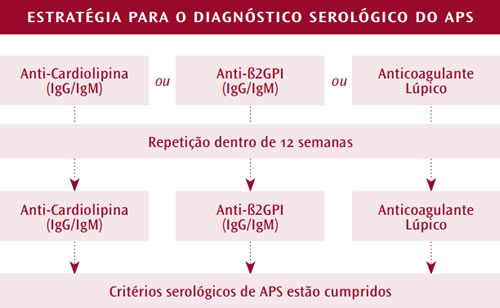
Presence of lupus anticoagulant in plasma on 2 or more occasions, with at least 12 weeks between tests.
Anticardiolipin antibody (IgG or IgM) in serum or plasma, present at moderate or high titers (>40 GPL or MPL), on two or more occasions, with a 12-week interval between tests.
Anti-β2GPI antibody (IgG or IgM) in serum or plasma, present at moderate or high titers on two or more occasions, with a 12-week interval between measurements. (Adapted from (58))
Laboratory results can only be evaluated starting 12 weeks after the clinical event (and never more than 5 years later); otherwise, the event may produce a false-positive result.
It is recommended that at least one of the following parameters be measured for the serological diagnosis of APS:
If you have any questions, please contact us.
We'll be happy to help.
CLINICAL PATHOLOGY LABORATORY

Related news:

Síndrome Antifosfolipídico: Os Critério… | 2018
O Síndrome Antifosfolipídico, também designado de Síndroma de Hughes, é uma alteração do sistema im…
Read more
Síndrome Antifosfolipídico, Uma Doença … | 2018
O Síndrome Antifosfolipídico caracteriza-se pela produção de anticorpos antifosfolipídicos direcion…
Read more