





Lipid Metabolism
Predictor of Coronary Heart Disease
The lipid profile is considered a powerful predictor of coronary artery disease (Framingham Study).
Measurements of lipids and apolipoproteins, as well as a lipid profile, allow for the characterization of different types of hyperlipidemia
Phenotypic Classification of Primary Hyperlipidemias
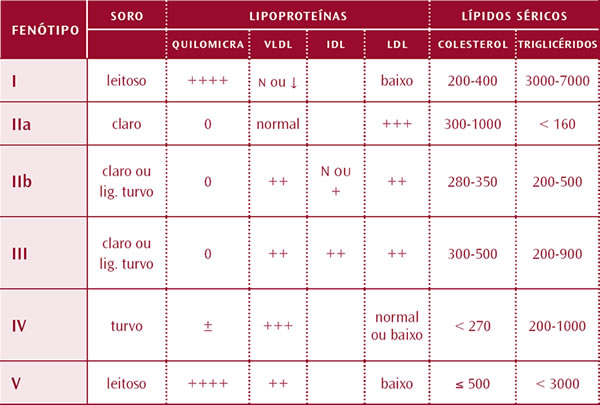
These biochemical and molecular studies are particularly indicated for:
- Individuals with elevated plasma cholesterol levels;
- Young individuals with a history of myocardial infarction and/or stroke and elevated plasma cholesterol levels;
- Family members with a diagnosis of familial hypercholesterolemia, to identify individuals at high risk for atherosclerosis.
Hyperlipidemias can be classified according to their genetic/metabolic etiology.
Genetic and Metabolic Etiology of Primary Hyperlipidemias
| Disease | Primary Abnormality | Metabolic Abnormality |
|---|---|---|
| Common Hypercholesterolemia | Multiple environmental and genetic factors | Increased LDL production and/or decreased LDL catabolism |
| Combined Familial Hyperlipidemia | Unknown | Increased production of VLDL and/or LDL ApoB100 |
| Familial Hypercholesterolemia (*) | At least 600 mutations causing LDL receptor dysfunction | Increased production of LDL and/or decreased LDL catabolism |
| Residual Hyperlipidemia (Type III) | Coexistence of non-functional apoE isoforms associated with alterations in VLDL/LDL metabolism, whether acquired or inherited | Failure of residual particles to convert to LDL |
| Familial Hypertriglyceridemia | Unknown | Increased VLDL production and/or decreased VLDL catabolism |
| Chylomicron syndrome | Deficiency of lipoprotein lipase or its essential cofactor, apo-CII | Inability to metabolize chylomicrons |
Etiological Classification of Primary Hyperlipidemias
| Disease | Phenotype | Coronary Risk |
|---|---|---|
| Common Hypercholesterolemia | IIa | + |
| Combined Familial Hyperlipidemia | i IV | ++ |
| Familial Hypercholesterolemia (*) | IIa; IIb; IV | ++++ |
| Residual Hyperlipidemia (Type III) | III | +++ |
| Familial Hypertriglyceridemia | IV; V | ? |
| Chylomicron Syndrome | I; V | |
| HDL Hyperlipidemia | ||
| Beta-Sterolemia | ++ |
Familial Hypercholesterolemia
For the evaluation of Familial Hypercholesterolemia (*), an inherited metabolic disorder associated with a high risk of coronary heart disease and a worldwide prevalence of 1 in 500, the Dr. Germano de Sousa Center for Laboratory Medicine offers the following test:
1. Mutations in the LDL receptor (LDLR) gene
Mutations in the LDL receptor (LDLR) gene prevent the catabolism of the daily LDL pool, leading to very high plasma LDL concentrations, which can reach two to three times the normal level.
Several studies have shown a significantly increased incidence of coronary artery disease in relatively young individuals—whether heterozygous or homozygous—with very high LDL levels. Several studies point to a correlation between different types of mutations in the LDLR gene and patients’ response to statin therapy; therefore, molecular characterization may be relevant to treatment options*.
2. The ApoB gene mutation (3500R>Q)
The ApoB gene mutation is associated with hypercholesterolemia, an increased risk of ischemic disease, peripheral arterial disease, and a risk of hypertension.
The analysis of LDLR gene mutations is performed by complete sequencing of the gene’s coding regions and promoter.
The analysis of the ApoB gene mutation is performed by sequencing exon 26 (where the mutations described to date in the literature are located), and complete sequencing of the gene’s coding regions and promoter may also be performed.
To maximize clinical and laboratory diagnosis, the Dr. Germano de Sousa Center for Laboratory Medicine offers a panel of biochemical and molecular biology parameters that enable a correct and appropriate characterization of the hyperlipidemia in question.
These include:
- Total Cholesterol
- LDL Cholesterol Fraction
- VLDL Cholesterol Fraction
- HDL Cholesterol
- Triglycerides
- Apolipoprotein AI
- Apolipoprotein B100
- Lipoprotein (a) (Lp(a))
- Lipoprotein Electrophoresis
- LDL Receptor Gene Mutation Analysis
- ApoB Gene Mutation Analysis
If you have any questions, please contact us.
We'll be happy to help.
CLINICAL PATHOLOGY LABORATORY

Related articles:

The Lipid Profile
Diseases of the circulatory system are the leading cause of morbidity and mortality in Portugal.
Read more